
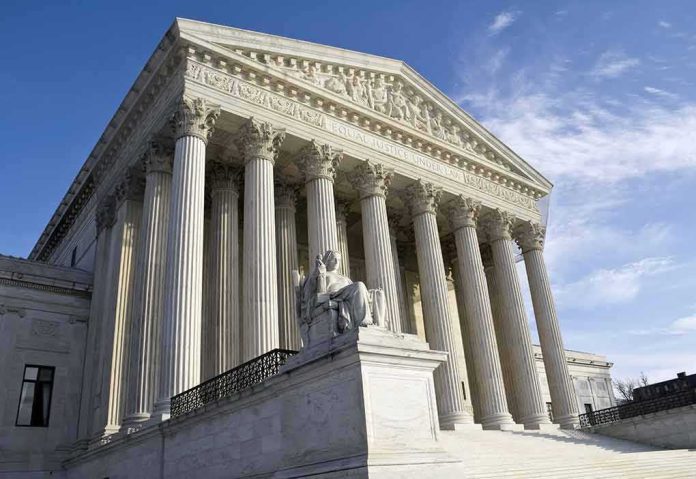
Two Supreme Court justices from opposite wings just teamed up to question whether police can wreck your property and owe you nothing.
Story Snapshot
- Justice Sonia Sotomayor, joined by Justice Neil Gorsuch, flagged a major Takings Clause gap.
- The justices said courts should not dodge payment when government directly takes or keeps property.
- Lower courts are split on a “police power” shield when officers destroy homes or cars.
- The Court denied review but called the issue open and in need of more cases.
Why Two Justices Sounded the Alarm
Justice Sonia Sotomayor wrote that courts need to answer a basic question: Does a police-power exception let the government avoid paying when it destroys or keeps private property? Justice Neil Gorsuch joined her. Their statement came as the Court declined to hear several petitions. They said some cases were not the right vehicles. But they warned that people who claim a classic taking, like when the government keeps sale proceeds, deserve more than a shrug from courts.
The warning matters because the Fifth Amendment says the government must pay just compensation when it takes private property for public use. Cities and police say emergency action is not a taking at all. That fight is not new. But the cross-ideological nudge from Sotomayor and Gorsuch made it hard to ignore. They did not announce a final rule. They asked lower courts to sharpen the lines and explain where a police-power limit comes from in law or history.
What Split Courts Are Doing Right Now
Federal appeals courts do not agree. The Seventh Circuit has treated damage under police power as outside the Takings Clause. The Ninth Circuit has avoided a blanket rule and used a “necessary” standard instead. That means some owners get no chance to ask for payment after police blow out walls to catch a suspect. Others can argue that officers went beyond what necessity allowed. The split leaves homeowners guessing which side of a state line decides their fate.
The Supreme Court’s recent denials keep those splits in place. In O’Donnell v. City of Chicago, the Court declined review, but the justices left a breadcrumb trail. Sotomayor called the question open and said lower courts should keep working the problem. She also pointed to a clean line between regulation and a taking. When the government takes property for itself or to settle a debt, a badge and a “police power” label should not erase the duty to pay.
The Real-World Stakes: Homes, Cars, and Sale Proceeds
Property owners have told stark stories. Police have destroyed homes during manhunts. Cities have seized and sold vehicles over unpaid fines and kept the surplus. The legal issue turns on categories. Was this emergency destruction to protect life, seizure of evidence, nuisance abatement, or a direct appropriation? Sotomayor’s statement pressed courts to stop using a magic word—“police”—as a free pass when the facts look like a classic taking that the Constitution covers.
Critics of a pay-the-owner rule say necessity must control. They argue that when an officer must act to save lives, the Constitution does not require compensation. Some judges have agreed. Others say necessity can be a defense to liability but does not erase the Fifth Amendment’s promise to spread public burdens fairly. The conservative case for compensation is simple: if the public benefits from the sacrifice of one owner, the public, not the victim, should bear the cost. That view aligns with common sense and with a deep American respect for property rights.
What The Court Did—and Did Not—Decide
The Court did not decide the merits. A denial of review changes nothing in binding law. But two justices wrote plainly that lower courts need to do more work. They flagged the lack of a clear source for any police-power exception. They also hinted that direct appropriation and retention cases are strong candidates for compensation. Readers should not treat this as a green light to sue and win every time. It is a signal that the door is open wider than some cities claim.
Two unpaid parking tickets can cost a Chicago driver the car.
Chicago may impound a vehicle while the owner's ticket debt stays unpaid. The city can then keep the car, sell it, or surrender it to a lienholder, with no compensation, no offset against the debt, and no return of…
— @DMartinoLaw (@DMartinoLaw) October 26, 2026
Owners and local governments now face a map with different rules. The next strong case will likely feature an innocent owner, intentional destruction tied to an operation, clean records, and a direct clash between circuits. That case could force a final answer. Until then, the smart move for cities is to plan for claims and carry insurance or set aside funds. The smart move for owners is to document losses, preserve records, and press claims where the law allows.
What To Watch Next
Watch for petitions that present a single, focused pattern, not a mix of seizures and sales. Track filings that build the history of necessity, wartime destruction, and nuisance law. Expect more briefs that show the difference between protecting the public and keeping a person’s value in the public till. When that clean case arrives, do not be shocked if Sotomayor and Gorsuch again stand shoulder to shoulder. They have already told the country the question is ripe.
Sources:
reason.com, supremecourt.gov, law.cornell.edu