

Trump’s tariff threat puts a price tag on Mexico’s response to migrant caravans—and dares Mexico to prove enforcement beats excuses.
Story Snapshot
- Large migrant groups moved through Mexico toward the U.S. border, creating a real enforcement test, not a hypothetical one.
- Some migrants tried to breach the border near Tijuana, prompting arrests and deportations on both sides.
- Mexico showed it could detain, deport, and redirect caravans, while also offering work permits and humanitarian options.
- Trump’s core argument: stop caravans before they reach the U.S. border—or face trade pain.
What triggered the tariff warning
President Trump warned that Mexico must stop large migrant groups before they reach the U.S. border or face higher tariffs. Caravans formed in Central America, then moved through Mexico in organized waves, sometimes numbering in the thousands. These were not rumor mills. They were bodies on roads and bridges. The push north created a practical test: could Mexico stop caravans early, or would U.S. agents face the crush at the line? Trump said handle it upstream or pay at the port.
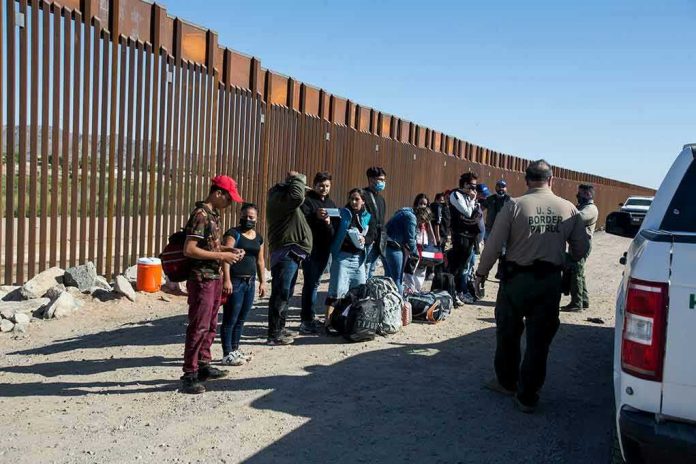
Border agents dealt with more than talk. Near Tijuana, some migrants rushed barriers. U.S. agents made arrests. Mexican authorities also deported people tied to the clash. That incident set the tone. Mexico could not claim the caravans were only a march when attempts to cross the line forced both countries to act. For many Americans, this moved the debate from theory to duty. Secure the border. Stop chaos. Keep agents from facing crowds at the fence.
Mexico’s capacity was real—and uneven
Mexico proved it could disrupt caravans. Officials deported thousands of Central Americans in the same time frame and detained groups linked to new caravans. Mexico also halted a separate caravan and offered temporary residency, work papers, health care, and schooling to those who stayed in the south rather than surge north. That mix matters. It shows enforcement tools existed, and humanitarian tools existed. The question for U.S. policy was not capability, but will and timing.
Mexico pushed back on blame. Officials said Mexico does not promote illegal migration and cannot make U.S. immigration decisions. They framed the caravans as public demonstrations and stressed rights to request asylum or humanitarian visas under Mexican law. That legal framing explains why Mexico did not slam the door shut everywhere. But it does not erase the fact that arrests, deportations, and dispersals happened when authorities chose to move. Both realities can be true at once.
Trump’s pressure logic and the trade lever
Trump’s public theory was simple: stop caravans long before they reach the U.S. border. He tied the issue to border security, election urgency, and deployments. He also tied it to trade leverage, which he later used in 2019 with a stepped tariff threat that paused after Mexico agreed to tougher enforcement. The current warning to double tariffs follows the same template. Make inaction expensive. Reward results. Keep the pressure until the line holds.
NEW: Donald Trump threatens to double tariffs on Mexico if it does not halt more than a thousand migrants walking north toward the US border. pic.twitter.com/mervZMoJya
— HIT.com (@HIT) November 12, 2026
Trade hawks will back the squeeze. They see a clear government-to-government deal: Mexico has tools, so use them. Civil libertarians will protest. They point to tear gas images, family hardships, and legal rights to seek asylum. Both sides can point to facts. What matters for policy is outcomes. When Mexico used enforcement and offered work permits in the south, pressure eased near the U.S. line. When caravans pushed north, agents faced disorder and arrests rose.
Tough questions that decide what happens next
Three questions cut through the noise. First, will Mexico scale early enforcement each time a caravan forms? Past actions show it can, but consistency is the gap. Second, will humanitarian options in southern Mexico draw people to stay rather than head north? Mexico’s “You Are in Your Home” offer tried to do that, with work and services attached. Third, does tariff pressure change Mexico’s choices fast enough to matter at the border? The 2019 episode suggests yes, at least in the short run.
Tariffs are a blunt tool, and they hit both economies. But border chaos is not free either. Communities pay when schools, hospitals, and local law enforcement absorb the spillover. Border agents pay in safety and morale. Voters see a basic fairness test: a sovereign nation controls its border. On that test, Trump’s demand tracks common sense. Stop large groups before they become a crisis at the line. Use the tools Mexico already showed it has.
Bottom line
Large caravans turned a policy debate into a logistics puzzle with a clock. Mexico demonstrated real enforcement power and offered legal pathways in the south. Some caravans still pushed to the U.S. border and triggered clashes. Trump’s message is the same as it was in 2018: prevention beats response. If Mexico stops caravans early, tariffs stay holstered. If not, trade pressure comes fast. The next caravan will show which choice Mexico makes—and how serious the tariff threat is.
Sources:
facebook.com, abcnews.com, bbc.com, rappler.com, apnews.com, migrationpolicy.org, sandiegouniontribune.com, sltrib.com, mprnews.org, trumpwhitehouse.archives.gov, kpbs.org